
Dakar – lessons from the longest race on earth. Part 11
January 12 - Stage 8 Today is the longest Special (Dirt race section) of the Rally. 171 km liaison, 487 km special, then another 171 km liaison back to the bivouac. It was a mix of terrain. First it was fast, then dunes, then fast, then dunes, rocks, fast again,…

Dakar – lessons from the longest race on earth. Part 10
January 11 Stage 7 Coming off rest day in the desert somewhere near Riyadh. Trying to sleep in the bivouac is not easy. There are helicopters coming and going - like the one for the Crown Prince of Saudi Arabia. Apparently, there are a lot of princes, and one is…

Dakar – lessons from the longest race on earth. Part 9
Did you ever set out to do something out of your comfort zone, and you are unsettled by it, and it's challenging, but once you are there and it seems to be going well, a feeling of satisfaction comes over you? You are proud of what you are doing? You…

Dakar – lessons from the longest race on earth. Part 8
Stage 4 - January 7. Twice in this race they had the racers do something especially challenging. We raced 450 kilometers one way, where they gave you a tent and sleeping bag. You pitched your tent in the middle of nowhere, and in the morning you raced back. No mechanics. …

Dakar – lessons from the longest race on earth. Part 7
Stage 2 was 100 Kilometers of liaison and 400 kilometers of special. At the start we were in rocks. Now, when I say rocks, I mean rocks you can't go around. Rocks with no dirt. Nothing but rocks. Flat tires are a big concern. You carry two spare tires. If…

Dakar – lessons from the longest race on earth. Part 6
Stage 1 Each race vehicle is given a specific start time, 30 seconds apart. There were 380 total race vehicles, I think. Our start time was 10:50 am. Our mechanics had changed the turbo out the night before. The way this works in these rallies is that you go on…

Dakar – lessons from the longest race on earth. Part 5
I have never been to Saudi Arabia. I never thought I would be. What's it like? Is it safe? I've never been to Istanbul, Turkey, either. We landed there after an 11-hour flight. It looked like a place I would go back to. Beautiful spots. Great food. The people looked…

Dakar – lessons from the longest race on earth. Part 4
People ask - "Do you ship your car over there?" "Who works on the car?" "Who supports you?" I asked all those same questions. There are 1000 logistical things to do to race Dakar. It's 5500 miles! You wake up in one place, and go to bed 600 miles away! …

Dakar – lessons from the longest race on earth. Part 3
Did you ever have "imposter syndrome"? Where you don't feel like you belong here? Where everyone else seems to know what they are doing and what is going on, and you are trying to figure it out? When you ask "What am I doing here?" There is still a poor…

Dakar – lessons from the longest race on earth. Part 2
Sometimes, getting to the starting line is half the battle. Getting to the first day on the job. Getting to line up as a competitor. Getting in the game. The Dakar Rally is the longest off road race in the world. It started in 1977 when Thierry Sabine got lost…

Dakar – lessons from the longest race on earth. Part 11
January 12 – Stage 8
Today is the longest Special (Dirt race section) of the Rally. 171 km liaison, 487 km special, then another 171 km liaison back to the bivouac.
It was a mix of terrain. First it was fast, then dunes, then fast, then dunes, rocks, fast again, then just crap.
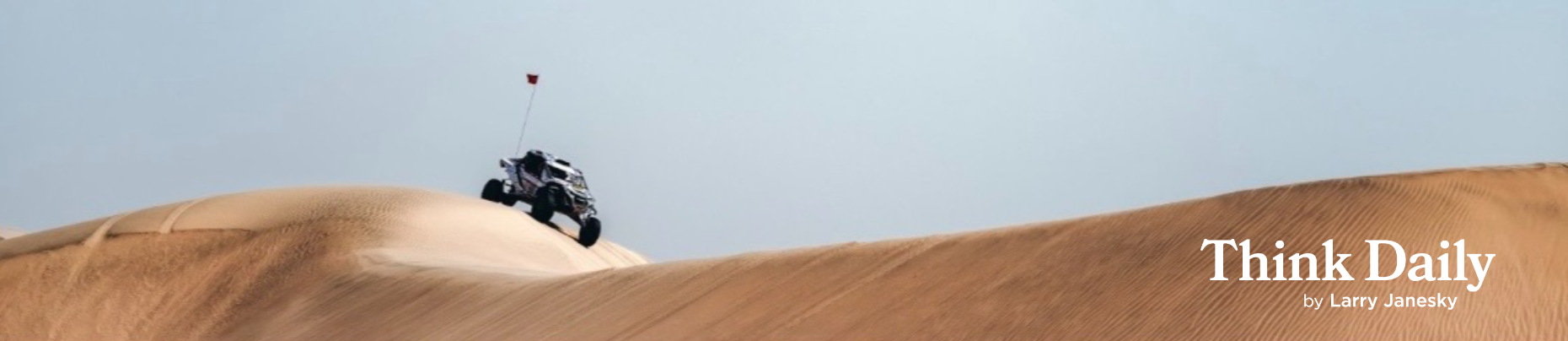
It was a tough day. It started with dunes – big ones. BIG. We were behind another car when we approached the foot of a huge dune. Another car had failed and was coming down at us. In the dunes, you have to get on the gas and get momentum and speed, or you will not make it up and over. Your engine is whining at max rpm, but your speed is slowing and slowing as you go up. If you feel you aren’t going to make it you have to turn down and around, otherwise you will bury all four tires and be stick on a steep slope. It is sketchy when you turn down because when you are off camber, you feel like you are going to flip over. You have to get the nose pointed down as soon as possible if you abort.
So this guy is coming down at us, and the guy in front of me decides to go left and around. I follow. Soon, we are making virgin tracks. My plan is to cut right when I can and find the race line to rejoin it. The sun is directly overhead, and my eyes can’t make out the shapes or the dunes or even see where the crest is. I’m surprised by sudden drops, I did not see coming. The color of the sand in front of me is the same as the sand of the higher dune in the distance, and it all blends together. I am feeling uncomfortable.
I can’t drive aggressively like you should in the dunes because I don’t want to crest a dune at speed and flip the car forward end over end, as happens to more than a few drivers. We drop down a 20-foot slope, and the sand is super soft. All four wheels dig in easily, and we are up to the skid plate in sand. We are in a bowl – uphill on all sides. Worst-case scenario. Dennis gets out and gets to work. He is not reporting progress. I get out. It’s bad. I start digging with the shovel, but digging is not the whole answer because the undercarriage is already on the sand at the bottom of this bowl.
The wind is blowing the sand up the slopes, and the sand is falling over the crests. I see our deep tracks erased in minutes. The dunes are being reshaped in real time before our eyes. They are alive.
We have to put the two boards we have under the front tires, and jack the car up with the jack to put sand under the rear tires to lift them up. We are jacking, and the bottom of the jack is going down and down, instead of the top coming up. Quicksand.
I thought we were done. From the looks of it, I didn’t think we’d ever get out. Of course, I did not give up. At this point, we’d die out there. (A little dramatic. They have helicopters.) We were off course. A chase truck could not get to our location, I didn’t think. But we needed to finish, and we were early in the stage. After 45 minutes, we thought we were ready to try to drive out. The lowest part of the bowl was, unfortunately, at my seven o’clock position. I had to get out going uphill, and turn sharply at the same time.
I get in, start it up, and try. I go three feet and bury in again. Oh no! Not good!
We get back to work. Same procedure. This time, by some miracle, and with engine revving and movement at a snails pace, I was able to inch forward and drive out. Whew!
We lost 1 1/2 hours. Now we had to find the course. While digging, I could hear engines in a direction over two giant crests. I was worried about getting stuck now more than ever. I burst through virgin sand to find the course line.
I was grateful the rest of the day for still being in the race, no matter how much time we lost. The overheating problem seemed to be solved. We got back at 8:30 pm. We were both very cold.
Tomorrow – we go one-way camping in a tent again.
Oh the joys…
Leave a Comment Cancel reply
Dakar – lessons from the longest race on earth. Part 10
January 11 Stage 7
Coming off rest day in the desert somewhere near Riyadh. Trying to sleep in the bivouac is not easy. There are helicopters coming and going – like the one for the Crown Prince of Saudi Arabia. Apparently, there are a lot of princes, and one is in charge of motorsports, and he had a big helicopter. Then mechanics are working on vehicles all over the bivouac, and they have to start them and test whatever they were working on. There is loud revving engine noise all night closeby. This is Dakar.
This stage is another long one – 875 km. 271 liaison, 450 special, 260 liaison.
Second half. Here we go. I felt like each mile driven now put me closer to the finish. But I had a long way to go.
It started with big dunes. We were “surfing” the dunes – where you wind along the crests at the tops, when a photographer was standing at the crest right in our line. People ask me how we got such epic pictures. Well, the race organization and South Racing hire photographers to station themselves in the most epic places and take pictures. They send you a link to your photos by the end of the day. It’s amazing.
Well, we almost ran one of them over. We had to abort our good line and turn down into a bit of a hole to save the poor fellow’s life. But we got stuck in the sand. Dennis got out to assess the situation and to dig us out. Meanwhile, other cars were going by us really close, and one car came over the berm and nearly T-boned us. We lost 15 minutes. We were lucky in many ways.
Our overheating issue persisted, and Dennis was calling the temperature to me often. Again, it was intermittent, but climbing soft sand dunes was one thing the car did not like from an engine temperature perspective. I was worried we’d blow this engine and it would all be over. We had to put water in twice.
We both had our face shields changed the night before. Wiping abrasive dust off your face shield all day puts little micro-abrasions in it until it seems cloudy. We got new shields, but little did we know, they were the “cheap ones”. They marred up within hours and we were struggling to see. By nightfall, with headlights, I could not see very well at all to drive the car. Good thing I had a backup plan. I brought $2 safety glasses that I bought in Baja, Mexico, with me. I put them on and raised my shield just a bit to see through. It worked and saved us!
The dunes gave way too fast, flat sections and then small canyons with rocky passes between them. We were chasing two cars that were both in our class just ahead of us. Suddenly, the first one veers off to the right wildly. The next one veers suddenly to the left. It was almost as if they were pulling over to let me pass. Then – “Boom – Boom!” I realized what happened. There was a sharp tire-eating rock that they both hit. Then we hit it for two flats at once!
Good thing we had two spares. In Baja, we only carry one. Dennis changed the tires and now we had to be extra cautious as we had no more spares. Our flat-less streak was broken. Dang. We lost 30 minutes and finished 115th overall, and 24th in our class.
On the two-hour liaison in the cold darkness back to the bivouac, we were following another car. Remember, in the liaison road sections, we are not being timed. Dennis realized that he had missed a turn 15 km back. Nobody saw it in the black night. We flagged him down and told him but he did not believe us. He elected to keep going. We turned back and went a long way. To be honest, I doubted Dennis was right. Then he started doubting it himself, but he said the road book said keep going back. We were cold and tired, and an hour and a half from the bivouac. Finally, we found this important hidden turn, and were headed the right way home. When you are in a foreign country, in the middle of nowhere, in the cold night, with limited food and gas, you can get into a bad situation quickly. Ask me how I know.
I was tired. Very tired.
Six stages to go.
Leave a Comment Cancel reply
Dakar – lessons from the longest race on earth. Part 9
Did you ever set out to do something out of your comfort zone, and you are unsettled by it, and it’s challenging, but once you are there and it seems to be going well, a feeling of satisfaction comes over you? You are proud of what you are doing?
You never know what you can do if you do not try.
I took stock of where I was. In Saudi Arabia, in the most remote locations, racing in the longest race on the planet. Pinch me. I’m actually here doing it.
Ted was doing great with his duties, taking enough footage, interviews, and setting up GoPro cameras on the car each day so we could make a movie later. The question is – how will it end? I guess that part was my job.
South Racing continued to wow me. I became great friends with my mechanics, the cooks, and the whole staff. At Dakar, everyone is in the same boat. We are all talking at dinner about our day, the challenges, and our problems. Egos are out the door by now. We are all helping each other however we can.
Stage 6. A long one today. A whopping 925 Kilometers. 270 km liaison, 336 km special, and 260 km liaison back. That’s far. The liaisons were very cold sitting there at the speed limit on the road. But during the day, it was perfect – cool – no sweating.
Today, ALL DUNES!
Today was the day to see if I had shaken the dune curse for good. We started the special in the dunes, watching cars launch up over the first high crest and disappear. Our turn. Let’s go!
I did great! I did not feel sick all day. Up and down. Up and down. Up, up, up, and doooooown. Early on, I followed an “ultimate class” car closely. I learned some lines from him. It’s an advantage to follow another guy because you can see how fast his car disappears over a crest. If it’s a gentle slope on the other side or a sharp downhill, you can see it and ride the crest appropriately yourself. After 30 minutes or so, we were on our own.
We got the four-wheel drive figured out – good thing because in this soft sand, we needed it. After 200 km, we had to stop to add water to the engine again. The problem was not getting fixed. We were thinking it was a head gasket. They had changed the radiator, hoses, and all kinds of things to try to fix it, yet we were still losing antifreeze.
At one point, the car would not go over 90km/hr. But Dennis found a low gear switch that was engaged.
We were in the dunes for the last hour. Our lights were not good like the lights we have in Baja. But here they don’t expect you to be out at night for too long. In Baja, you are racing sunset to sunrise. Dennis told me something surprising – he had never navigated at night before. I probably had 100 hours of night racing experience. It didn’t worry me – but these lights seemed like 2 candle-power. Geez.
I was really happy about my driving. The dunes were tough. Another South racing car aborted the day when it got dark. He would not drive in the dunes at night for how scary it can be. He was out of the Dakar Rally for that.
My mechanics were thrilled that I went six days without a flat or any major damage. They say it is a Dakar record. Put me in the record books, coach! Hey, it’s something!…..
We finished 110th on the day, 19th in our class – the best yet. We are in 107th position overall for all four-wheel vehicles.
We got back to the bivouac at 10 pm. I got to bed at 12:30 am. Late. Here’s the great news. There is a “rest day” – no racing for a day in the middle of the rally. Tomorrow was a rest day! We were near Riyadh and could perhaps go to the city for a visit. But there was no way I’d have time. There was much to do, including REST!
I had finished the first half of the Dakar Rally. Many did not. I had the terrain and the driving figured out. There was no terrain type they could throw at me now that I was not comfortable in. At least I thought…
I was tired and grateful.
Thanks so much for sharing your Dakar experience with us! I am loving reading it and imagining the experience ups and downs that happened between the words you’ve shared! It’s applicable to do much of life.
Leave a Comment Cancel reply
Dakar – lessons from the longest race on earth. Part 8
Stage 4 – January 7.
Twice in this race they had the racers do something especially challenging. We raced 450 kilometers one way, where they gave you a tent and sleeping bag. You pitched your tent in the middle of nowhere, and in the morning you raced back. No mechanics. Only two spare tires.
The course was fast all day. In our class, SSV, we had a speed limiter – we could go up to 135 km an hour, or 84 miles an hour. We were at that a lot. It’s scary when you get dusted out and can’t see where you are going at 84 mph!
The engine was getting hot and we were concerned. Too hot and the engine blows and we are out of the race. Towards the end we had to stop and put four liters of water into the radiator. It must have been leaking out somewhere. Hopefully that somewhere was not through the head gasket into the engine. After we got the checkered flag, it was only one kilometer to the camp. It turned out to be a majestic setting where the flats rolled up against small mountains made of near vertical rock.
As far as the overall standings, at the end of Stage 1, we were in 181st place out of about 280 four-wheel vehicles. After stage 2 – 150th. After Stage 3 – 135. And now after stage 4 – 120th.
Sometimes, you just keep showing up in life, long after your competition has failed, lost interest, retired – and you are ahead just because you kept showing up.
We got our tent, our sleeping bag, and a box of food. Tent pitched, food hydrated with water, and eat. Sun sets, climb into the tent and go to sleep. I’m a side sleeper, and the hard ground made for a bad night’s sleep with my shoulders and hips hurting. In the morning we awake to the beautiful setting. Instant coffee, eat, and wait a bit for our start time, watching other vehicles start from a perch up the rocks.
Stage 5 was leaving this remote place and making our way back to the bivouac, which was normal, moved hundreds of miles since we saw it last. They pack everything up – this whole city, and move it long distances, and set it up again. Usually, just in the time we are out on the course. It’s a miracle of logistics, planning and teamwork.
The course was fast all day. We’d be going along and suddenly the car would come out of 4-wheel drive. If I was turning, we’d start to fishtail. Later, we would learn that we were just in the wrong electronic “mode”. We did not know the car well enough at that moment.
The car continued to run hot, but it was intermittent. We could not explain it. It would be hot, then the temperature would come down. Later, it would heat up again. We had to stop for ten minutes to add four liters of water again. We finished 115th overall in all four wheel classes, and 24th in our class – the best yet. We were now 116th overall. The mechanics fixed the water leak (so they thought) and replaced a broken sway arm.
I felt good – better every day. The days are long, but my brain accepted it. This is what we do every day. We drive – fast in rough terrain – ALL DAY LONG. That is our life right now.
Dennis is great. He is smart, experienced, and calm. No drama. Being from South Africa he has an accent. (He says it’s me.) Speed zones near villages or camel paddocks are either thirty kilometers per hour or fifty. Well, the way the South Africans say “thirty” and “Fifty” sounds the same. Especially though headphones with tons of background engine and tire noise. We had enough misunderstandings and clarifications that I asked him to say “Third Eye” or “Fitty Cent”. He laughed and complied. It worked.
Dennis – “In 300 meters, speed zone, fitty cent.”
Me – “Got it”
Yeah — catching on fire would not have been good.
These are very inspirational Larry 🙏💪
Keep it moving-all four on ground, you are living the life.
I’m thinking fire would be a great motivator to make that exit process go a lot quicker!
I am also grateful you did not catch on fire!
Leave a Comment Cancel reply
Dakar – lessons from the longest race on earth. Part 7
Stage 2 was 100 Kilometers of liaison and 400 kilometers of special. At the start we were in rocks. Now, when I say rocks, I mean rocks you can’t go around. Rocks with no dirt. Nothing but rocks. Flat tires are a big concern. You carry two spare tires. If you get more than two flats, your in trouble. Many drivers got four flats this day. Good for them there was an area where they can meet their chase teams and get new spares. I saw more than one car on more than one day driving with a flat – sometimes to where the tire was shredded off the rim – but they had no choice but to try to nurse it in.
For the third day of racing, we did not have any flat tires. Maybe it’s my sharp eye for the smoothest lines from being a motorcycle rider all those years. If you hit the wrong rock on a bike, it could be disastrous. At high speed – deadly.
Yesterday we finished 31st out of 38 in my class. Today we finished 30th. I was getting my rhythm slowly. My goal was to finish. It did not matter what place I finished. The difference between finishing 15th or 30th was tiny compared to the difference between finishing and not finishing. I was in it to survive.
When someone passes you they make dust and you cannot see. You hope for a crosswind. I would back off so the dust would thin out until I could see because I do not want to make a big mistake. But by slowing down, the next guy behind you pushes a button to pass you. That will make a buzzer go off three times in your car so you know he wants to pass. If he pushes three times on you, you have to pull over and let him by. That puts you in the dust again, and the cycle is repeated.
One driver flipped his car and crashed out just 1.5 kilometers into the Prologue! He was out. Heartbreaking. I did not want that to be me.
The way it works is that if you just finish each day, you will move up in the rankings because each day other guys are out. I wanted to just keep finishing cleanly, and I had to remind myself that I wasn’t here to race anyone. I know – it’s a funny strategy for a race, but the right one for Dakar.
On this stage we were in the dunes late in the stage. It got dark on us and we were in the dunes at night. Cresting a dune and falling into the black abyss is unnerving. I learned to surrender to it and keep going. We finished, proud of what we had done.
The next day was Stage 3. It was January 6, 2026. We had a very long one today – 725 kilometers. 420km was the “Special”, or the timed dirt section. We saw cars upside down, a truck on it’s side, and cars crashed all over the place. Not as many cars were passing me today. We’d see a car pass us, and then he has a flat tire later and we pass him. Sometimes they’d pass me again, and then he is broken down and we pass him, with some comment like “Look at you now!”. I know that is not very sportsmanlike, but in the fury of the race, it seems appropriate.
The terrain was beautiful. Red canyons with orange sand sloped up in between them by the wind. We finished the special and had a two hour liaison in the cold wind to get back to the bivouac. We have no windshield, and it gets cold at night – down to 50 degrees or so. We were frozen when we rolled in at 9 pm.
The mechanics loved me – there was not much for them to fix! No flats again. They tore down the car anyway, maintaining and tuning, looking for structural cracks and problems waiting to happen. The poor mechanics, three of them, were up almost all night every night.
Stage 3 complete. Feeling good about it all now.
Meanwhile South Racing put Ted to work. He had to drive our RV from one bivouac to the next. That could be 7-9 hours on paved road. And Saudi Arabian roads are boring. They are flat as a pancake and straight as an arrow. And aside from the occasional small rocky mountain, there is nothing to look at. There are no trees, no grass, and well, nothing in most places. Just flat and barren. Poor Ted.
I felt like I was racing in places where few humans ever go. Amazing scenery in the interior places. I felt privileged to see God’s creation.
Just 6000 kilometers to go, or something like that – but who is counting…
Gorgeous photos! I love these blogs because I almost feel as though I’m there. Thank you for sharing!
I look foward to the next part!
Keep the wheels on the ground.. you inspire me! Today im thankful for you
I know you made it safely because you are writing these blogs. But can’t help feeling the suspense o this adventure. Look forward to reading them.
Leave a Comment Cancel reply
Dakar – lessons from the longest race on earth. Part 6
Stage 1
Each race vehicle is given a specific start time, 30 seconds apart. There were 380 total race vehicles, I think. Our start time was 10:50 am. Our mechanics had changed the turbo out the night before.
The way this works in these rallies is that you go on the paved road for a while first. That is called the “liaison”. The reason is that to find a proper flat place big enough to set up the bivouac and to find a proper place to race, well, they aren’t always in the same place. So you start at your assigned time, run the liaison on the road at a speed limit, get to the timed dirt section called the “special”, and then start the real racing. At the end of the special, your racing time is over, and you take another liaison back to the bivouac.
If you get stuck out there or have a problem you have to fix, you get into the bivouac later, which means the mechanics have less time to work on your car, and you get less sleep. If you do not finish a stage, you are out of the race.
Stage one went great. I can drive the car; that is not a problem. This car is a turbo – a real rocketship compared to the normally aspirated car I race in Baja. It was 8 hours in the car. There were some dunes at the very end of this stage. I did great. What a relief to have the first dunes behind me!
My kidneys were really hurting from the bouncing. We were in the car for 8 hours. I forgot to wear the kidney belt I brought with me. The rest of the rally I did not forget. That night I went to the physical therapist that South Racing brought with them – yes – Dakar is no joke, and you need that some days! He fixed my back, and my kidneys were not a problem from then on.
There were 12 more days of racing ahead of me. But I tried not to think of that. I took it one moment at a time. What do we have to do next? Get this dusty racing suit off. Take a shower at the shower trailer. Eat. Get what I need ready for tomorrow. Do an interview with Ted. Post photos on Facebook. Go to sleep. Wake up 90 minutes before the start time. Eat. Get gear on. Go through the checklist. Put food in the car. (There is no lunch out there.) Get in the car. Strap in and hook up. Drive to start, find the car number that is ahead of you, and get behind it.
One stage complete.
Good.
These are my favorite Think Dailys!! 8 hours in the car…when do you go to the bathroom? Do you take breaks along the way to refuel the car and eat a little? Do you refuel or does the team meet you somewhere?
I am loving hearing about your Dakar experience!
Leave a Comment Cancel reply
Dakar – lessons from the longest race on earth. Part 5
I have never been to Saudi Arabia. I never thought I would be. What’s it like? Is it safe?
I’ve never been to Istanbul, Turkey, either. We landed there after an 11-hour flight. It looked like a place I would go back to. Beautiful spots. Great food. The people looked cool to me. Then a 3 1/2 hour flight to Yanbu, Saudi Arabia.
We got in late. We went through customs and immigration without any problems. The Rally sent a bus to pick up a full load of racers from many countries. It’s dark. On our way from the airport, the clock strikes midnight. New Year’s. It’s 2026 now. Nobody really noticed or said anything, except me and Ted acknowledging it to each other. Dakar is weightier than New Year’s – noted.
We pull into a dusty parking lot. All places there are dusty. There is no rain. No vegetation. Ted and I aren’t really sure what is going on.
We all get off and walk up to a light inside a tent. They check our names against the registration list and give us wristbands. Back in the bus. We get to enter the bivouac. It’s a French word that means camp. Bivouac. It’s a small city. We find our way to the South Racing set up. They are there to meet us. They show us our RV. We meet Dennis, my codriver. Three of us sleeping in a small RV.
The next day we met more people from South Racing who were taking care of us. They had semi trucks set up – a mobile kitchen with two chefs from Poland. A guy from South Africa running the food in front. A expandable glass semi-trailer you could sit in and eat and get out of the cold/wind that had a coffee machine and snacks all the time. Multiple semi trucks for parts and tools and even spare engines. A tent set up over every race car. A real professional operation.
There were guys and a few women from all over – Italy, Germany, Portugal, Spain, France…and that is just with the 80 people that South Racing had to take care of 11 race cars. They were all in my class – “SSV”. And they were all CanAm Maverick R models. Five of them were the CanAm factory race team. South Racing has a partnership to support five factory-backed CanAm teams. The other six teams were privateers like me. They were from England, Turkistan, Scotland, Spain, France, etc.
Then we had to go register for the race, get interviewed, and take the car and our gear to tech inspection. The bivouac was amazing. When I was a kid, I liked Matchbox cars. But a pack of them invariably had some weird-looking cars. As a kid, I said to myself, there are no cars like that. I had never seen cars that looked like that. Well, now I know where they came from – Dakar. They have some unique designs there that they have been running for many years. Euro race cars are no joke either. It’s funny to see a Mini and think it’s cute. Then they start it, and it sounds like a big block Chevy with headers on it.
Dennis was 54. I am 61. He was chill like me. We were very compatible. I was happy about that.
The next day, we had to “Shake down” the race car. It would be the first time I was driving the car. A 20 Kilometer loop was set up. Dennis navigated, and I drove. We got to know each other and know the car. We did a second lap and were satisfied. When we got back, we talked to our mechanics about a few adjustments, and we were ready.
Tomorrow, the race starts with a short 40-kilometer “warm-up” called the “Prologue”. Finally, after a year and a half of getting here….
I went to bed about 10 pm. I woke up at 11. Oh no. I had two fears coming here. The dunes, and getting sick again. I did so much to prevent it. I brought some of my own food. Nuts, dates, healthy snack bars, peanut butter – calorie-rich stuff I could carry. The race is tomorrow. I was puking and….
Based on this story, you might think I am fragile and get sick a lot. No. Not me. I never got sick in Mexico, where I have raced over twenty times. But this stomach bug in the Middle East has my number. I was moaning all night with every exhale. I was lying two feet from Ted. Poor Ted. Both guys heard every biological rumble and squeak – all night. No sleep at all for me.
In the morning, I managed to get up and go to the medical tent. They gave me some stuff to take and I went back to the RV to lay down more. I was still under attack. Our start time was 3 pm, as it was only 46 kilometers of racing on dirt. Surely another hour and it would be over…right? 9 am. Moaning. 10 am. Can’t sit up. 11 am. Still. I did not think I could race.
Are you kidding?! All this…trying to finish the longest race in the world and I can’t even make the Prologue?! Am I out before it starts?
Noon. Finally, the cloud lifted, and Satan left my body. No sleep, but I was glad to be able to sit up.
By 3 pm, I was able to eat a little and get my gear on.
I feel like I should be given a medal for starting after all I had been through! Or at least a hug.
Green flag. I am racing the Dakar Rally! Finally!
46 Kilometers. The car was running good until we lost our turbo and could only go 90km an hour instead of 135 as a top speed. One other big problem – my kidneys were killing me. It got so bad I didn’t want to hit bumps anymore – and it’s all bumps!
Tomorrow – Stage 1. 460 kilometers. (285 miles).
Leave a Comment Cancel reply
Dakar – lessons from the longest race on earth. Part 4
People ask – “Do you ship your car over there?” “Who works on the car?” “Who supports you?” I asked all those same questions. There are 1000 logistical things to do to race Dakar. It’s 5500 miles! You wake up in one place, and go to bed 600 miles away! You are in a foreign country. You need food, shelter, parts, instruction, and assistance of all kinds.
Fortunately, there is a guy who can help you. His name is Scott Abraham, and he has a company out of Germany and Portugal called South Racing.
“Hello, is this Scott Abraham?”…
Weeks before the race, my co-driver, Bruno, tells me he can’t be my navigator. He got hired by a team who is racing a lot of rallies and he has to take their offer, as I was just racing one rally – the BIG one, but just one. This is how he makes a living. He’s a pro.
So where am I going to get a co-driver this late? I call Jamie. I call Andrew Short, a former motocross pro who is a codriver now. He gives me a name of a guy in South Africa – Dennis Murphy. He’s navigated in the last 6 Dakar’s. Are you available? I got lucky. He said yes. I hope he is a cool guy because we are going to be sitting side by side in high-stress situations all day for 14 days, and I have to listen to him tell me what to do.
I finally leave for the Dakar Rally on Monday. I wake up Saturday at 4 am to use the bathroom. I am walking like a drunk. I almost fell down. I had to catch myself on the door frame. What is going on?
I get back to bed and lay down. The room is spinning violently. I close my eyes and wait. I almost puke. It subsides. I worry and wonder, and eventually fall back asleep. I wake up later – the room starts spinning again. Each time I move my head, it starts, and lasts about 15-20 seconds. When I move again, it starts again.
What is going on? Oh no! I have to go to Dakar!
I use Chat GPT to find out what it could be.
Vertigo.
Vertigo?
“How do I fix it?”
If it is a certain kind of vertigo, and it sounds like it is, the Eppley maneuver can fix it. I go to YouTube. I try this series of movements. It takes five minutes. I almost puke, but it fixed it! I feel crappy all day.
Basically, it’s a crystal that gets into your semi-circular tube, and when you move your head, it tells your brain you are spinning. Imagine a snow globe with one flake in it. The Eppley maneuver gets that flake to go all the way around the circle and drop out of the tube. A miracle.
The next morning I wake at 6 am. The room is spinning again. I do the Eppley maneuver again. Chat GPT said that half the time you have to do it twice. I hope this works. I have to get on a plane tomorrow, and I can’t even walk! It works again – but will it stick this time?
I am finally on a plane to Dakar. I have my friend and videographer Ted Waldron with me.
Getting to the starting line is not easy.
But I am not there yet…
Good luck on your journey!Hit that road Hard..
I can’ wait to read the next part you write telling your story, thank you Larry
Leave a Comment Cancel reply
Dakar – lessons from the longest race on earth. Part 3
Did you ever have “imposter syndrome”? Where you don’t feel like you belong here? Where everyone else seems to know what they are doing and what is going on, and you are trying to figure it out? When you ask “What am I doing here?”
There is still a poor kid from Bridgeport inside, and now you’re talking about going to Saudi Arabia to race what?
There is no school for racing in Dakar. There is no school for racing in Baja, for that matter. That’s why our Into the Dust movies are so popular on YouTube. They show how to do it, start to finish. You can’t see that anywhere else.
I learned that I’d have to go to Morocco to race a five-day rally there first. Then, if I finished, I could enter the Dakar Rally. Heck, I didn’t even really understand what a rally was. All the racing I had done was start to finish, and it’s over. A rally is different. You have a course to run each day. It’s called a “Stage”. They time you, and add your daily times together. If you do not finish one day, you are out. At the end, whoever has the lowest time wins.
I didn’t really care about winning; I just wanted to finish. Less than half of the top drivers in the world finish – even with a team of mechanics on your side.
So, I entered the Morocco Rally in October of 2024. My goal was to go to Dakar in January of 2025. I had raced 3 other races in Baja that year, and still had the Baja 1000 to race in November. That’s a lot of racing. A race is a one-week trip, usually. Morocco would be a ten-day trip. It’s a big commitment.
I’ve told the Morocco story before. Here’s a brief summary. Jamie recommends a co-driver from Argentina, Bruno Jacomy. I need a good co-driver to navigate. The navigation is not GPS – it’s a “road book,” and it’s very tricky. It’s a five-day rally. Day one goes well. On day two, we get into big sand dunes. I’m hot, and I get spatial disorientation. These dunes are like giant buildings. You can flip over the top lips easy. It’s undulating waves of tan. At midday with the sun straight up, there are no shadows, and what you feel and what you see are different. I puked. Many do. Dunes are not easy. I did not want to go on, but had to. Can’t stay way out here in the middle of nowhere. Bruno points – that way. Nothing but dunes. Mercifully, it ends on hardpack and rocks.
I’m told there are dunes for the next two days. OMG.
Morning number three, I wake up at 4 am. Ut-oh. I got it. The bug. I didn’t drink any water. But I got the microbe in me. Coming out of both ends. Really sick. Sweating. Moaning. I wonder if it will pass for me to race. I can’t miss a stage. I get up and get my gear on. Can’t eat breakfast. I am lying on the ground in front of my car, moaning. Time to go. I get in the car and strap in, wondering how I am going to go to the bathroom and thinking about how long it takes to get unstrapped and climb out of this thing and get this “onezie” race suit off.
We get the green flag, I go. But I can’t do it. I am so sick. The devil is in me. Sore you can push through. Hurt you can endure. Tired, you can put aside. But dizzy and sick like this? No. I pull over, get out, and get in the chase vehicle and lie down. Bruno drives the car on the road to the next bivouac. I thought I was out of the race. In Dakar, I would have been. In Morocco, as long as I start, I am still in the race!
Day 4 and big dunes are coming. I am worried. Will they be my downfall? I have no choice but to face my fear and figure it out. Here we go. I see them coming in the distance. Giant waves of danger and confusion. I figured it out and did well.
Day 5 – piece of cake. Finished!
I went home, and raced the Baja 1000 in November. Then I head to Dakar on Dec 30 as planned- right? I was burned out. Physically and mentally. Worn down to a nub. Shot. I can’t go to the longest Rally in the world and race 14 days in a row when my gas tank is on E before I even get there! What to do. Arrangements are all made. I have to bail. I postponed to January 2026. No choice. It turned out to be the right thing to do.
A year goes by. I dread the dunes all year. Saudi Arabia has way more dunes than Morocco. Sometimes you are in them all day long.
I leave for Saudi Arabia in a few days.
That’s when I thought it was over….
Wow! That makes me dizzy just thinking of it!
Leave a Comment Cancel reply
Dakar – lessons from the longest race on earth. Part 2
Sometimes, getting to the starting line is half the battle. Getting to the first day on the job. Getting to line up as a competitor. Getting in the game.
The Dakar Rally is the longest off road race in the world. It started in 1977 when Thierry Sabine got lost in the Libyan desert while riding his motorbike in the Abidjan-Nice Rally. After being rescued from the desert, Sabine retunred home facinated by the sand dunes that had trapped him. The Frenchman needed to share his discovery with as many people as possible. Back hime he drew up plans for a brand new rally; starting in Paris, travelling to Africa via the Mediterranean Sea, crossing the scorching Sahara Desert, and finishing on the shores of the magical Lac Rose on the outskirts of Dakar, Senegal’s capital city.
Sabine came up with a motto for the rally – “A challenge for those who go. A dream for those who stay behind.”
From 1979 to 2007 the Dakar travelled throughout Europe and Africa. Brave competitors came from all corners of the world to test themselves against “the toughest race on the planet”. Legends were made as an ever-changing route took the rally all over Algeria, Angola, Burkina Faso, Cameroon, Central African Republic, Chad, Egypt, France, Gabon, Guinea, Ivory Coast, Libya, Mali, Mauritania, Morocco, Namibia, Miger, Protugal, Congo, Senegal, Sierra Leone, South Africa, Spain, and Tunisia.
In 2009, they moved the race to South America – Chile, Argentina, Bolivia, Peru and Paraguay. Half a million fans greeted the arrival of the Rally with a street party in Buenos Aires.
In 2020, an entirely new landscape of desert playgrounds was unlocked as Saudi Arabia became the 30th country to host the Dakar.
“How do I enter?” I asked my friend Jamie Campbell who I had a shop that built my Baja race car. Jamie was selected by team Honda to drive an experimental hydrogen car in the race last year.
“Well, you can’t just enter the Dakar. You have to qualify” he said.
“How do I do that?”
“You have to race a shorter Rally. Like the Abu Dhabi race or the five-day Morocco Rally.”
This was going to be a bigger deal than I thought.
Do you give up when you hear that a goal or project will be far more involved than you imagined?
“How do I do that?” I asked…..
Never, never give up. The proper response to any challenge is, “How can I….”
Leave a Comment Cancel reply

Join the over 20,000 people who receive Larry's Daily Inspiring Messages
Larry values privacy and will never sell your information.
What an adventure of grit and perseverance. Looking forward to part 12